
The Montessori Method
The Montessori Environment
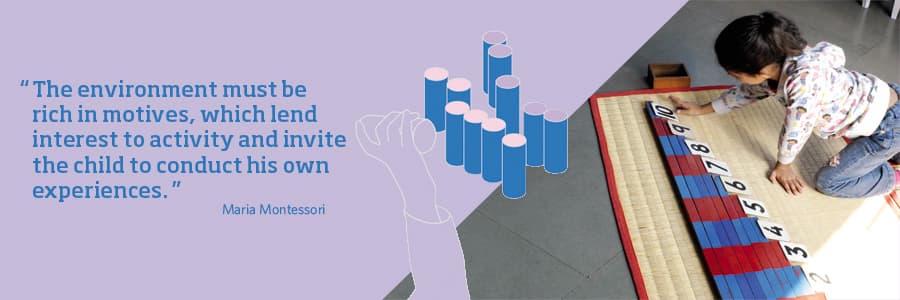
the magic years creates a child-sized world, incorporating the outside in an attractive yet seamless way, so that children can easily understand it and choose their own journey through it.
The environment respects and protects the child’s rhythm of life. The child develops concentration, self-discipline, independence, and respect for others and for his environment — skills that will serve him for a lifetime.
Carefully designed materials and activities stimulate independent exploration. The child progresses at his own pace within an individualised learning framework, moving from simple activities to more complex ones. Through this process his curiosity is satisfied, and he begins to experience the explosive thrill of discovering the world around him.
Working together, and alone
Children of all ages and abilities contribute to this environment. They may choose to work together or individually. Each child is allowed to work freely, choosing an activity that interests him, as long as he does not disturb the others. The encouragement of independent activity leads to real independence of mind and action, and this social environment — requiring an active regard for others — develops the child’s social skills.
The adult’s role is to assist the child in his development. The child is presented with the method of performing an activity, and then allowed to progress at his own pace.
Sensitive periods
The Montessori Method identifies certain periods in a child’s development when he shows an unusual interest in acquiring a particular skill. At no other time in his life will he be able to tackle that learning with such persistence, energy, independence and intelligence. It is during the sensitive period for language that the child learns to talk; at other times he will show an equivalent passion for order, for precise movement, for acquiring words and numbers, and more.
The the magic years educational programme maximises the advantage of these sensitive periods. It evolves dynamically, in keeping with the changing needs of the child and new discoveries in child development.
Programmes
There are three groups for admission. Ages are counted as on 1st April.
| Age | Programme | Days | Timings |
|---|---|---|---|
| 18 months | Infancy programme | Two days a week Tuesday and Thursday | Summer: 9:00 am – 12:00 noon Winter: 9:00 am – 12:00 noon |
| 2 years | Infancy programme | Three days a week Monday, Wednesday and Friday | Summer: 9:00 am – 12:00 noon Winter: 9:00 am – 12:00 noon |
| 2½ years | Pre-school programme | Five days a week Monday to Friday | Summer: 8:30 am – 1:00 pm Winter: 9:00 am – 1:30 pm |
Full admission details, including ages we admit and how to enquire, are on the admissions page.
Come and see the school
Visits are by prior appointment, on days set aside so the children’s work is never interrupted. Send an enquiry and we will arrange a time.